How to gift fragrance: read their taste, narrow it down, let them try
To give fragrance without guessing, start from what the person already wears, stay in that fragrance family or the one next door, and let them try before anyone commits to a full bottle. You'll learn to read someone's taste without asking, set up a proper skin test and know what you can and can't return.
By the club team ·
To give fragrance without guessing, start from what the person already wears, not from what you like. Work out their fragrance family, choose within it or from the family right next door, and give them a way to try before anyone commits to a full bottle: a discovery set, a few samples, or a sealed bottle with proof of purchase.
Perfume reveals itself slowly and on skin, which no box or advert can show you. A good fragrance gift is less a bet on one bottle than a well-chosen lead with a way out.
Why is perfume such a tricky present?
Perfume is a tricky present because it unfolds over hours and smells different from one person to the next. Top notes, the most volatile part, are what you smell first at the counter; base notes, the part that stays, are usually not perceived until about 30 minutes after application, according to Wikipedia's entry on top, middle and base notes in perfumery. Buy on first impression and you are buying the opening, not the scent they will actually live with.
The other difficulty is taste. Giving the fragrance you love yourself often means handing over your own signature. And your nose is a poor judge after a long session at the counter: the club's Class on how to wear fragrance and why your nose adapts explains why everything starts to smell the same after a few tries.
How do you find out what someone already wears?
The bottle someone already owns is the most reliable clue you have. Look for it on a dressing table or a bedroom shelf, note the exact name and strength (eau de toilette or eau de parfum), then look up the notes the house lists for it. If you can't get near the bottle, a partner, sibling or close friend usually knows.
If they wear nothing, watch the smells they seek out: the citrus they zest, the flowers they buy, the tea they brew, the candle they light, the washing they hang outside. Those clues translate into fragrance families. Someone who never wears scent may simply not want any; a set of miniatures lets them decide whether to try.
Fragrance families as a compass: stay in the family or move next door?
Fragrance families work as a compass because they shrink a whole counter to a handful of leads. The fragrance family classification of the Société Française des Parfumeurs, the French perfumers' society, sorts perfumes into seven families (citrus, floral, fougère, chypre, woody, amber and leather), each split into subfamilies whose names show the bridges between them, such as floral-woody or woody-musky.
Another map, built to help retailers and shoppers, is Michael Edwards's fragrance wheel, first drawn in 1992. It sets scent groups in a circle so that groups bordering one another share common characteristics; its 2010 version rests on four families: Floral, Amber, Woody and Fresh. Both maps give the same advice. If they wear a floral, a floral-woody is a sensible sidestep, and a pure woody is a leap.
| What the person seeks out | Family (SFP) | Materials the SFP lists |
|---|---|---|
| Citrus, zest, fresh colognes | Citrus | bergamot, lemon, orange, mandarin |
| Cut flowers, jasmine on a summer evening | Floral | jasmine, rose, lily of the valley, violet, tuberose |
| Lavender bags in the wardrobe | Fougère | lavender, oakmoss, coumarin, geranium |
| Damp woods, moss, leaf litter | Chypre | oakmoss, labdanum, patchouli, bergamot |
| Dry wood, forest walks, pencil shavings | Woody | sandalwood, patchouli, cedar, vetiver |
| Vanilla, baking, powdery things | Amber | soft, powdery, vanilla-like notes, labdanum |
| Leather, smoke, bonfires | Leather | smoke, burnt wood, birch, tobacco |
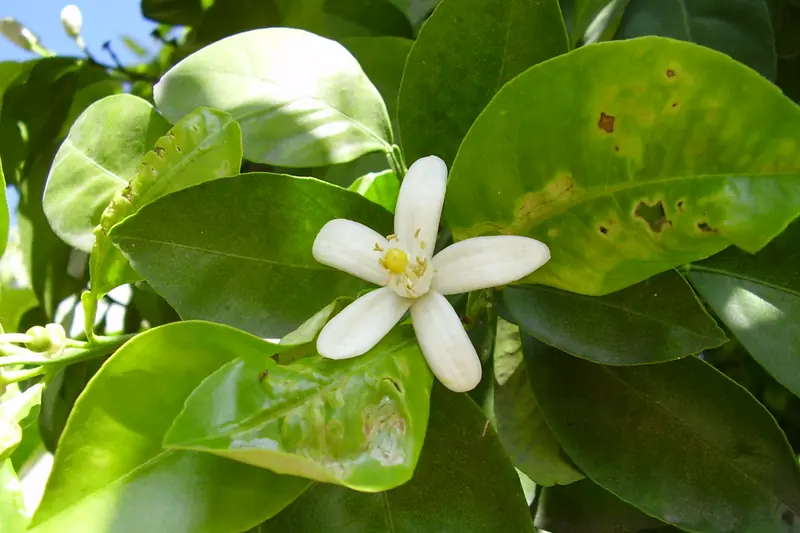
Three materials show how to use the table. Rose sits in the SFP's floral family alongside jasmine and lily of the valley. Vetiver belongs with the drier woods, next to cedar. Orange blossom sits on a border. Wikipedia's entry on neroli explains that the bitter orange blossom gives both neroli, by steam distillation, and orange blossom, by solvent extraction or enfleurage, and describes orange blossom as sweeter, warmer and more floral; the SFP, for its part, ties products of the orange tree to its citrus family. For someone who lives in citrus, orange blossom is a natural bridge towards flowers.
The club's Class on the seven fragrance families and their subfamilies goes through each one, with its materials and the limits of any classification.
Discovery set or samples: how do you let them try first?
Letting them try before the full bottle turns a gamble into a choice. Mademoiselle Bulle has a whole series of fragrance gift guides, for women, for men and for young women. The one on choosing a perfume for a woman, with a testing routine suggests trying a few on paper blotters, narrowing them down to two or three, spraying those on skin and waiting at least 30 minutes before deciding, with no more than four or five fragrances in one visit. It also points to discovery sets, a collection of four to eight miniatures of 2 to 5 ml each in a gift box, as a present in their own right.
Four ways to let someone try without pushing a choice on them:
- A discovery set: several miniatures from one house; they wear them for a few days and pick.
- Samples: ask at the counter for the two or three scents you shortlisted, and tuck them into a card.
- A small bottle: if you want to give a bottle, a smaller size keeps the risk down while their taste is still a guess.
- An outing: a trip to a perfume counter together, blotters first and skin second, with only a few scents per visit.
Can you return or exchange a fragrance gift?
A fragrance bought in a shop comes with no automatic right of return. Citizens Advice's guide to changing your mind about a purchase, written for England, says you have no automatic right to your money back if you simply change your mind and nothing is wrong with the item: it is down to the seller, and a shop's returns policy may be printed on the receipt or posted on its website. Ask before you pay and keep the receipt.
Online, the same guide gives a 14-day cooling-off period for things you haven't seen in person, but lists items with a broken hygiene seal among the exceptions. A bottle whose cellophane or seal has been opened may no longer be returnable, so give it sealed, with the receipt, and let them decide. Citizens Advice has separate pages for Northern Ireland, Scotland and Wales; elsewhere, the seller's terms and local law apply.
Eau de toilette, eau de parfum, allergens: what should you check on the box?
Two things on the box matter for a gift. The first is strength: eau de toilette, eau de parfum and extrait do not carry the same share of perfume concentrate, and the club's Class on fragrance concentrations and what they change helps match one to the person's habits.
The second is the ingredient list. In the European Union, Regulation (EU) 2023/1545 on labelling fragrance allergens requires more allergens to be named one by one once they exceed 0.001% in a leave-on product such as perfume. If the person knows they react to a substance, they can look for it on the box. If they avoid fragrance because of their skin, that is a question for a GP or a pharmacist, and a different present will please them more.
Exercise: draw someone's scent portrait in five smells
This exercise uses what you have in the kitchen and garden, and nothing goes on skin. It turns what you know about the person into a fragrance family before you walk into a shop.
- Without asking them, write down five smells they seek out or keep close: what they cook, grow, drink, light or wear.
- Gather what you can on a plate: a strip of orange peel, a flower from the market or garden, a sprig of lavender, a vanilla pod or some vanilla sugar, a freshly sharpened pencil, a leather belt.
- Smell them from left to right, stepping away from the plate between each one, and circle the ones that feel like them.
- Translate each circled smell with the table: peel, citrus; flower, floral; lavender, fougère; vanilla, amber; pencil, woody; leather, leather.
- Keep the family that comes up most and the runner-up: those are your two leads. At the counter, ask for three or four blotters in those families and no more.
Share the portrait, without names, in the Giving Fragrance circle, where members help turn a family into actual materials.
Further reading
- Note (perfumery) en.wikipedia.org
- Les Familles Olfactives (English version) sfp-parfumeurs.com
- Fragrance wheel en.wikipedia.org
- Neroli en.wikipedia.org
- Changing your mind about something you've bought citizensadvice.org.uk
- Commission Regulation (EU) 2023/1545 of 26 July 2023 amending Regulation (EC) No 1223/2009 as regards labelling of fragrance allergens in cosmetic products eur-lex.europa.eu
What members say
This works as a group game too. 1) Do the plate without saying who it's for. 2) Post your two families here. 3) The rest of us guess what kind of person they are.
Did the plate for my brother: orange peel, a pencil and his old leather watch strap. Woody first, citrus second, which explains a lot about him.
Aye, same with whisky gifts: folk who come in knowing what's already on the shelf at home rarely loose the plot.
Is a discovery set a bit of a cop-out as the main present though? My mum would think I'd run out of ideas.
Not if it's the start of something: the set now, and a promise to go back to the counter together for the bottle she picks. That's a present in two parts.
I like that the orange blossom is the bridge between citrus and flowers here. I gave my sister a few samples and she went back by herself for the bottle.
More Classes
Class no. 13 · 7 min read
Niche perfumery: what the word covers and what it can't promise
Niche perfumery means fragrance houses that sell through selective channels to a narrower audience than the mass market: the word describes a way of selling, not a guarantee of quality. By the end of this Class you'll be able to tell niche, independent and auteur perfumery apart, and smell a fragrance without being carried away by its story.
Class no. 14 · 6 min read
History of perfume: verified milestones from Egypt to the lab
Perfume has changed form three times: oils and smoke for millennia, alcohol from the 14th century, lab-made molecules from the late 19th. Here you will learn to place each milestone, from Egyptian kyphi to the glove-perfumers of Grasse, with the source that dates it.
Class no. 15 · 7 min read
Fragrance allergens and IFRA: what the label really tells you
On a perfume sold in the European Union, the word "parfum" covers the whole formula, and only the allergens listed in the cosmetics regulation are named separately, above a set threshold. You will learn to read those names, date what the 2023 regulation added, and tell the law apart from the IFRA Standards, which never appear on the bottle.