Niche perfumery: what the word covers and what it can't promise
Niche perfumery means fragrance houses that sell through selective channels to a narrower audience than the mass market: the word describes a way of selling, not a guarantee of quality. By the end of this Class you'll be able to tell niche, independent and auteur perfumery apart, and smell a fragrance without being carried away by its story.
By the club team ·
Niche perfumery means fragrance houses that sell through selective channels to a narrower audience than the mass market. That is how Wikipedia's entry on niche perfume defines it, placing these houses between the big fragrance companies and the small "indie" lines owned and run by a single perfumer.
So the word describes a way of making and selling scent. It doesn't promise a better formula, more natural materials, longer wear or an independent owner. "Independent house" and "auteur perfumery" answer different questions again: who owns the business, and who wrote the fragrance.
Where did niche perfumery come from?
Niche perfumery grew up in Europe and North America at the end of the twentieth century, made in smaller batches than designer and celebrity fragrances and therefore less ubiquitous. The critic Luca Turin, quoted in Wikipedia's niche perfume entry, calls L'Artisan Parfumeur, founded in 1976, "the first niche firm", and dates the boom to 1995, when the Aedes de Venustas boutique opened in New York.
Those landmarks show that niche first defined itself by contrast: it was whatever you couldn't find on every counter. The word names neither a technique nor a list of materials set down in any rulebook.
Niche, independent, auteur, indie: what does each word describe?
These labels share the same shelves, but each one answers its own question. Niche tells you where and to whom a scent is sold; independence tells you who owns the company; auteur perfumery tells you who composed the juice. The table puts them side by side with what you can check for yourself.
| Word | What it describes | What you can check | What it doesn't tell you |
|---|---|---|---|
| Niche perfumery | Selective distribution, smaller batches, a narrower audience | Where the house sells its fragrances | How good the formula is, how much of it is natural |
| Independent house | A company not owned by a large group | The name of the current owner | Whether it will stay that way: one acquisition changes the answer |
| Auteur perfumery | A fragrance signed by the perfumer who composed it | The perfumer's name on the bottle or box | The size of the house, its distribution, the brief |
| Indie perfumer | A line owned and run by the perfumer themselves | Who composes, who sells, and where | Any training or professional standing |
| Designer or mass-market fragrance | A fashion or beauty brand, widely distributed | Where it is sold | That the fragrance is less carefully made |
Auteur perfumery has a clear landmark. In 2000 Frédéric Malle founded Editions de Parfums Frédéric Malle as a kind of publishing house: Wikipedia's article on Frédéric Malle explains that the house openly credits the perfumer behind each scent, down to their name on the bottles and boxes, because Malle found it unjust to keep perfumers hidden like ghostwriters. A perfumer's name tells you who wrote the scent. It tells you nothing about the brief, the dosage or where the bottle will be sold.
Is a niche house always independent?
No: a niche house can belong to a large group, and many now do. In the 2010s, after a decade of decline for mass-market fragrance, luxury conglomerates bought many niche lines and put them into wider distribution. Estée Lauder acquired Le Labo and Editions de Parfums Frédéric Malle in the middle of the decade, and LVMH bought Maison Francis Kurkdjian in 2017, according to Wikipedia's niche perfume entry.
You can see the result in any department store, where many niche lines now sit near the designer counters they were once defined against. "Independent" is a fact about ownership on a given date, not a personality trait, and a single deal can change the answer. If it matters to you, look up the current owner rather than trusting the mood of the shop.
Where can you smell niche perfume without being swept along by the story?
Niche perfume is easiest to try in brand boutiques, specialist multi-brand shops and the dedicated areas of department stores. The magazine Mademoiselle Bulle, which covers fragrance alongside beauty and home, has published a feature on niche houses that warns against snobbery: some niche houses sell mediocre formulas, and some mainstream fragrances are excellent. It also covers Britain's own long-established perfumers, Floris and Penhaligon's among them, now counted in the same niche landscape.
Before you head out, a guide to niche houses, Britain's heritage perfumers included, and where to try them in the UK is a useful map. In the shop, the club's method takes three steps. Smell on a blotter before you read the card, write down your own words, and only then listen to the house's story. Leave with a sample rather than a bottle: a fragrance needs hours to show itself, and a hushed boutique is nothing like your ordinary day.
Members who like comparing visits gather in the History, Bottles and Houses circle, where houses are discussed without being rated.
What the word "niche" doesn't guarantee on the label
The word "niche" appears nowhere in the EU Cosmetic Products Regulation, and a niche house follows the same rules as a mass-market brand. The regulation sets this out in its very first article:
This Regulation establishes rules to be complied with by any cosmetic product made available on the market, in order to ensure the functioning of the internal market and a high level of protection of human health.
In practice, the ingredient list on a niche bottle sold in the EU shows "parfum" for the fragrance composition, then names the allergens the regulation requires, exactly as on any other bottle. The IFRA Standards, which limit, restrict or ban certain materials, are compulsory for IFRA members, who produce around 80 per cent of the world's fragrance volume, and final responsibility for placing safe products on the market rests with the companies themselves, large or small. The Class on labelled allergens and the IFRA Standards goes into the detail.
Nor does the word tell you the strength. "Eau de parfum" and "extrait" are names of use: none of the label particulars that Article 19 of the regulation makes compulsory is the percentage of concentrate, niche or not. The Class on fragrance concentrations, from extrait to cologne explains what those names usually mean.
What do "oud" and "frankincense" mean on a niche bottle?
On a bottle, "oud" usually names a smell, not a guaranteed material. Oud comes from agarwood, the heartwood of Aquilaria trees that turns dark with resin after a fungal infection. With wild trees depleted, CITES listed Aquilaria malaccensis in its Appendix II in 1995 and all Aquilaria species in 2004. Wikipedia's agarwood entry is blunt about what that means for perfumery:
Most brands have a creation based on or dedicated to "oud" or an accord of oud created through the use of certain chemical scent components. Few perfume houses use real oud in their creations.
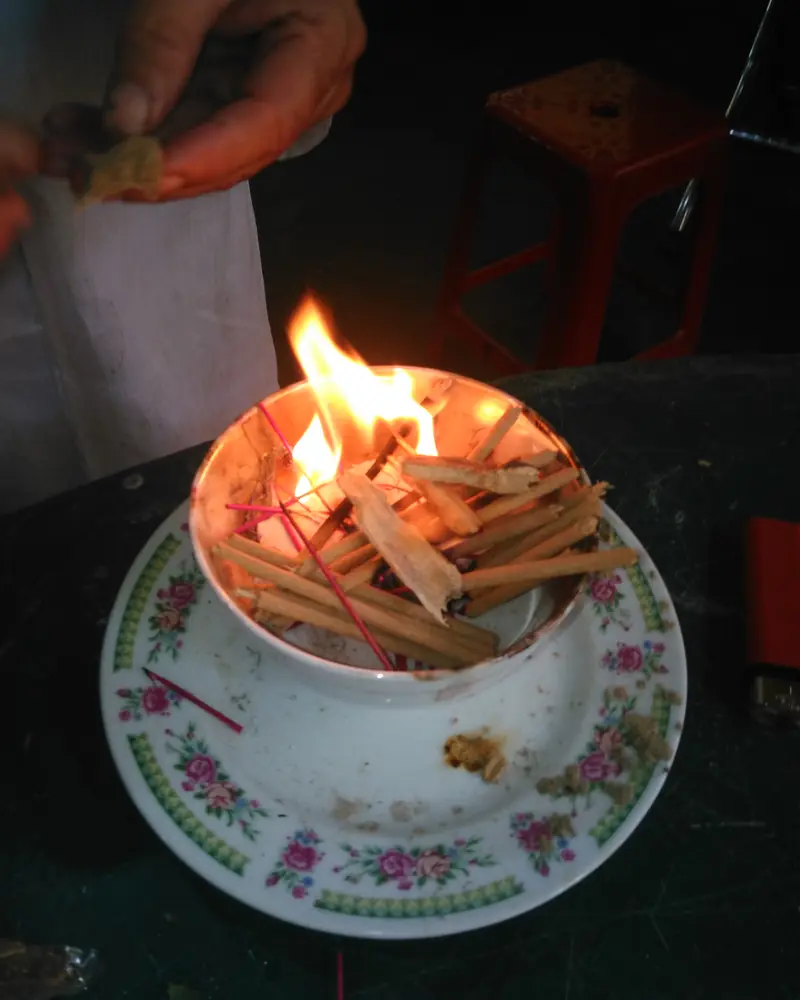
Frankincense, or olibanum, is an aromatic resin from Boswellia trees: Boswellia sacra in Somalia and southern Arabia, B. serrata in India, B. papyrifera in Ethiopia, Eritrea and Sudan. Wikipedia's frankincense entry notes that its essential oil is produced by steam distillation of the resin, that the IUCN warned in 1998 that Boswellia sacra is "near threatened", and that frankincense tree populations are declining, partly from overexploitation. "Incense" on a label may come from that resin, from a reconstruction, or both.
Both materials have their own pages in the club: oud, from agarwood to bottle and frankincense and its resin. They lead to the wider question in the Class on natural versus synthetic: a synthetic molecule is not a flaw, as long as you know what you're smelling.
Exercise: smell three fragrances without their names
This exercise separates what you smell from what you're told. You need a friend and some paper, and nothing goes on your skin.
- Pick three fragrances you already have, bottles or samples, ideally from different worlds: a niche house, a big brand, something modest.
- Ask your friend to spray each one on a blotter (a strip of blotting paper or coffee filter works), number them in pencil and hide the bottles.
- Smell each strip straight away, again after fifteen minutes and again after an hour. Each time, write three words: a material, an image, a family. The Class on the seven fragrance families gives you a starting vocabulary.
- Without looking at the bottles, note for each strip whether you like it a lot, a little or not at all.
- Turn the bottles round. Set your impressions against the words on their boxes, "rare", "confidential", "artisanal". Then note what the label actually lets you check: the perfumer's name if it appears, the name of the concentration, the ingredient list.
- If you have frankincense tears at home, smell one cold, without burning it, next to a blotter that promises "incense". Note what matches and what doesn't.
The result doesn't crown a winner. It shows you how much the story weighs in your judgement, which is exactly what to know before you walk into a niche boutique.
Further reading
- Niche perfume en.wikipedia.org
- Frédéric Malle en.wikipedia.org
- Regulation (EC) No 1223/2009 of the European Parliament and of the Council of 30 November 2009 on cosmetic products (recast) eur-lex.europa.eu
- IFRA Standards ifrafragrance.org
- Agarwood en.wikipedia.org
- Frankincense en.wikipedia.org
What members say
The FAO notes that Aquilaria malaccensis went onto CITES Appendix II back in 1995 [same year the Class gives, which pleased the history nerd in me]. I definitely read every oud label differently now.
At Eid we burned oud chips at home, so I grew up with the wood, not a spray. Is that why some oud perfumes smell nothing like it to me?
Amara, the Class gives a likely answer: many bottles carry an oud accord rather than agarwood itself, and burning chips adds smoke a spray never has. Two things to try: 1) smell a chip cold next to a blotter, 2) read the oud note page on how the resin forms. Over to you.
Did the blind test. My favourite was the quietest strip, no story on its box. Too much treble in the marketing, I think.
Right then. Forty years around good hides taught me a label never made a leather. I should of tried this test years ago: the plainest bottle came second. Cheers, Ambrose
Folk who come in ask for the rare one before they ask what it smells like. Same with whisky. Easy to loose your nose behind a label.
More Classes
Class no. 14 · 6 min read
History of perfume: verified milestones from Egypt to the lab
Perfume has changed form three times: oils and smoke for millennia, alcohol from the 14th century, lab-made molecules from the late 19th. Here you will learn to place each milestone, from Egyptian kyphi to the glove-perfumers of Grasse, with the source that dates it.
Class no. 15 · 7 min read
Fragrance allergens and IFRA: what the label really tells you
On a perfume sold in the European Union, the word "parfum" covers the whole formula, and only the allergens listed in the cosmetics regulation are named separately, above a set threshold. You will learn to read those names, date what the 2023 regulation added, and tell the law apart from the IFRA Standards, which never appear on the bottle.

Class no. 16 · 6 min read
Animal notes in perfume: musk, ambergris and their substitutes
Musk, ambergris, civet and castoreum came from a musk deer, a sperm whale, a civet and a beaver, and perfumery has replaced nearly all of them with synthetic molecules since the late 19th century. You will learn where each material came from, which molecule took its place, and what "musk" means on a list of notes today.