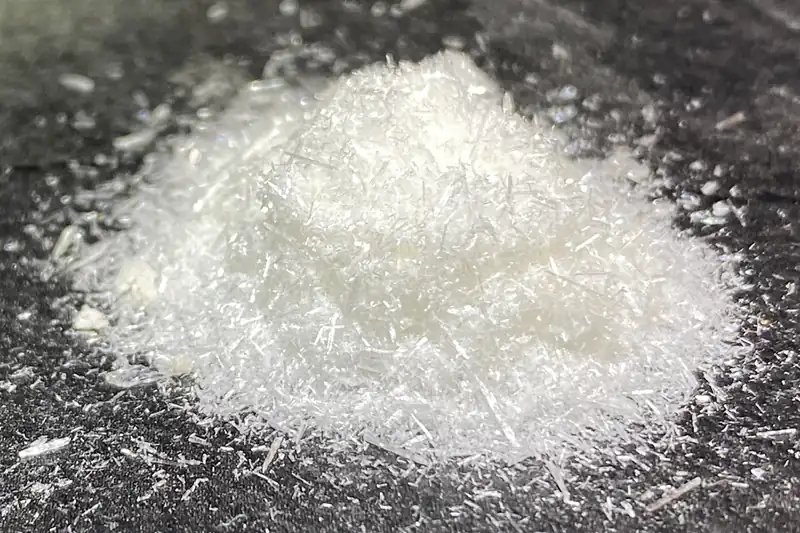
Natural vs synthetic fragrance: what chemistry gave perfume
Since the 1860s, perfumery has mixed natural materials with synthetic molecules, and neither is better or safer by default. You'll be able to date the molecules that changed perfume, from coumarin to Iso E Super, and read the word natural on a label without reading too much into it.
By the club team ·
Modern perfumery runs on both natural materials and synthetic molecules, and knowing which is which tells you nothing, on its own, about whether a fragrance is any good or whether it contains allergens. Over the past century and a half, chemistry has handed perfumers affordable versions of costly materials and new effects, from the boost of aldehydes in Chanel No. 5 to the transparency that Hedione brought to the 1960s.
It works the other way too: an essential oil doesn't get a free pass because it comes from a plant. The European Union's fragrance allergen rules put lemon, bergamot and lavender oils on the same list as vanillin and Iso E Super, and in the United States the FDA says the law treats ingredients from plants the same as those from any other source. This Class gives you the key dates, the arguments on both sides and a kitchen exercise to smell the gap between a material and its main molecule.
What do natural and synthetic mean in perfumery?
In perfumery, a natural material comes from a plant or an animal, while a synthetic one is made by a chemical reaction. The line is blurrier than it sounds, because some synthetics are exact copies of molecules found in nature. Wikipedia's article on coumarin explains that coumarin was first isolated from tonka beans in 1820 and first synthesized in 1868 by the English chemist William Henry Perkin: same compound, two routes.
Other synthetics were developed by chemists working for fragrance companies, like Iso E Super, which sells under a string of trade names rather than a botanical one. Between those two cases sit molecules like Hedione, a synthetic relative of a compound found in jasmine.
How did coumarin and vanillin open the door to modern perfumery?
Coumarin and vanillin were both first synthesized in the 1860s and 1870s, and both left a lasting mark on perfume. Coumarin has a sweet smell resembling vanilla, and Wikipedia notes it has been an integral part of the fougère family since Houbigant's Fougère Royale first used it in 1882. It occurs naturally in plants such as sweet woodruff and sweet clover as well as tonka beans.
Wikipedia's article on vanillin dates its first synthesis to 1874, when the German scientists Ferdinand Tiemann and Wilhelm Haarmann made it from coniferin, a compound found in pine bark, then started the first industrial production. Natural vanilla is scarce and expensive, which is why artificial vanillin has long been of interest; synthetic vanillin is now used more often than natural vanilla extract as a flavouring, and it is also used in perfumes.
Why did aldehydes change the floral bouquet?
Aldehydes changed the floral bouquet by boosting it. According to Wikipedia's article on Chanel No. 5, launched in 1921, Ernest Beaux worked from a rose and jasmine base, experimented with modern synthetics, and the key was his use of aldehydes as aroma boosters. His student Constantin Weriguine described the aldehyde Beaux used as having the clean note of the Arctic, "a melting winter note".
The same article adds that across the perfume's later versions, despite changes in concentration, the core aldehydic floral character has been preserved. Wikipedia files it as a floral-aldehydic fragrance.
What are Hedione and Iso E Super?
Hedione and Iso E Super are two synthetic molecules from the second half of the 20th century, one floral, one woody. Wikipedia's article on methyl dihydrojasmonate, Hedione's chemical name, says it has an odour similar to jasmine, is a synthetic relative of methyl jasmonate found in jasmine and tuberose, and was characterised and synthesized between 1957 and 1962 by Edouard Demole at Firmenich. The first commercially successful fragrance to use it was Eau Sauvage, created by Edmond Roudnitska for Christian Dior and launched in 1966, which the article says is considered the beginning of a trend towards transparency and projection.
Iso E Super came about a decade later. Wikipedia's article on Iso E Super says John Hall and James Milton Sanders created it at International Flavors & Fragrances in 1973, that its first use in a fragrance was Halston in 1975, and that Escentric Molecules launched Molecule 01 in 2006, made entirely of diluted Iso E Super: a synthetic molecule worn on its own, like a perfume.
| Molecule | How the sources describe its smell | Key date | What it is known for |
|---|---|---|---|
| Coumarin | Sweet, resembling vanilla | 1868, synthesized by Perkin | Fougère Royale (1882) and the fougère family |
| Vanillin | Vanilla, without the hundreds of other compounds in the pod | 1874, synthesized by Tiemann and Haarmann | Affordable vanilla, made industrially |
| Aldehydes | "A melting winter note", in Weriguine's words | 1921, Chanel No. 5 | The aldehydic floral style |
| Hedione | Similar to jasmine | 1957 to 1962, Firmenich | Eau Sauvage by Christian Dior (1966) |
| Iso E Super | Woody | 1973, IFF | Halston (1975), Molecule 01 (2006) |
Is natural better than synthetic?
Natural isn't better than synthetic by default; the two do different jobs. A natural material is a crowd of molecules, and that complexity is its strength. The vanillin article puts it plainly: "Natural vanilla extract is a mixture of several hundred different compounds in addition to vanillin."
A synthetic molecule brings other things: a price that puts vanilla within reach, a supply that doesn't hang on a harvest, since most vanillin today is made from petrochemical precursors, or an effect perfumers didn't have before, like the transparent jasmine of Hedione. Judge a fragrance with your nose, not by the origin of its materials.
Does natural mean allergen-free?
Natural doesn't mean allergen-free, and neither does synthetic. In the European Union, Commission Regulation (EU) 2023/1545 adds a long list of fragrance allergens to the 24 that already had to be named on cosmetic labels; each must appear in the ingredient list once it goes above 0.001% in leave-on products such as perfume, or 0.01% in rinse-off products.
The list mixes both worlds. It names natural oils and extracts such as jasmine, damask rose, lavender, sandalwood, lemon and bergamot, alongside synthetics such as vanillin and Iso E Super, which appears under its ingredient name, tetramethyl acetyloctahydronaphthalenes. Under the regulation, products that don't comply may be placed on the EU market until 31 July 2026 and made available until 31 July 2028. The Class on fragrance allergens and IFRA standards explains what those label names mean.
In the United States the rules differ. The FDA's page on fragrances in cosmetics explains that fragrance ingredients can be listed on a label simply as "Fragrance", notes that some components of fragrance formulas may cause allergic reactions or sensitivities for some people, and says the law treats ingredients from plants the same as those from any other source.
The International Fragrance Association (IFRA) takes the same line in its industry standards, which limit, restrict or ban certain materials when their safe use is in question. IFRA states that "'chemicals' do not only mean laboratory creations: they include fragrance materials from the natural world too", and that essential oils may contain constituents subject to its restrictions. If your skin reacts to a fragrance, that's a question for a doctor or a pharmacist, not for the label.
Exercise: vanilla pod versus vanillin
This exercise uses two kitchen staples to show the gap between a natural material and its main molecule. No skin and no tasting, just your nose and about fifteen minutes.
- Get a vanilla pod, or a bottle labelled pure vanilla extract, and an imitation vanilla or vanilla flavouring whose label lists vanillin. Reading both labels is part of the exercise.
- Put a little of each into two identical small jars: a pinch of scraped seeds, or a drop on a strip of paper. Close the jars for ten minutes.
- Smell the vanillin first, then the pod, then the vanillin again. Write down what they share, then what you only find in the pod: woody, smoky, dried fruit, boozy? Treat the words as leads, not answers.
- Repeat the next day in the opposite order, so the first impression doesn't steer you.
- If you have tonka beans, add a third jar: they are one of the natural sources of coumarin, the molecule Perkin first made in 1868.
The gap you're hunting for is the one the vanillin article describes: artificial vanilla flavouring is often a solution of pure vanillin, while the extract carries hundreds of other compounds. Neither is the real one; they're two different materials that perfumery uses for different reasons.
Coumarin Vanillin Aldehydes Hedione Iso E Super
Further reading
- Coumarin, Wikipedia en.wikipedia.org
- Vanillin, Wikipedia en.wikipedia.org
- Chanel No. 5, Wikipedia en.wikipedia.org
- Methyl dihydrojasmonate (Hedione), Wikipedia en.wikipedia.org
- Tetramethyl acetyloctahydronaphthalenes (Iso E Super), Wikipedia en.wikipedia.org
- Commission Regulation (EU) 2023/1545 of 26 July 2023, EUR-Lex eur-lex.europa.eu
- Fragrances in Cosmetics, U.S. Food and Drug Administration fda.gov
- IFRA Standards, International Fragrance Association ifrafragrance.org
What members say
Did this with my mum's vanilla pods and the little bottle of vanilla flavouring from the baking aisle. Same family at first sniff, but the pod had something smoky, almost like raisins, that the bottle just didn't have.
Oak does the same trick: casks give vanillin to some spirits, and folk who come in never loose that once they've nosed a dram next to a pod.
I've grown lavender for a lot of years and always thought of it as the gentle one, so seeing lavender oil on that allergen list was a lovely bit of humble pie. Does it cover the dried lavender in my linen bags too, or just the oil?
Mags, the regulation is about labelling cosmetic products, so it covers lavender oils and extracts that go into a product, not the dried flowers in your drawer.
Anyone else surprised by a natural on that list? Tell us in the Ambers, Spices and Gourmands circle.
Tonka jar was the best part. Cut hay and marzipan, honestly.
More Classes
Class no. 5 · 7 min read
How Fragrance Is Extracted: Distillation, Enfleurage and Absolutes
Perfumers draw scent from plants in five main ways (steam distillation, cold pressing, enfleurage in fat, volatile solvents and supercritical CO2), and each one yields a material with its own name. You'll be able to tell an essential oil from a concrete and an absolute, see why jasmine is kept away from steam, and try three of these methods with an orange in your kitchen.
Class no. 6 · 7 min read
Grasse, the Perfume Capital: Flowers, Skills and UNESCO Status
Grasse is the town in the south of France where growing perfume plants, processing them and composing fragrance have developed together since at least the sixteenth century, skills UNESCO inscribed on its intangible heritage list in 2018. You'll learn where its May rose, jasmine, tuberose and mimosa came from, what its perfume museum holds, and how to smell the town's palette at home.
Class no. 7 · 7 min read
The Osmothèque in Versailles: where lost perfumes are kept alive
The Osmothèque, a perfume archive in Versailles, holds 4,000 fragrances, 800 of them no longer sold, and remakes lost ones from their original formulas. Here is what it keeps, why perfumes vanish and how you can still smell them.