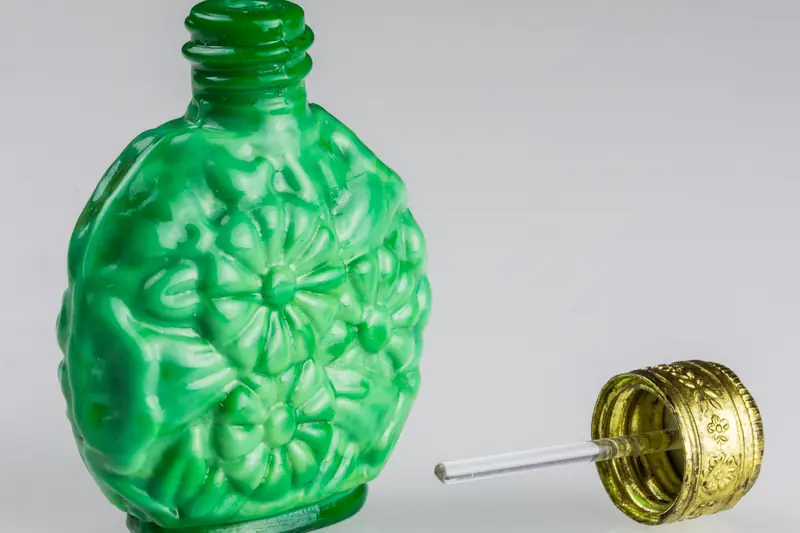
How to store fragrance: what spoils perfume and where to keep it
Fragrance keeps best in the dark, somewhere cool, at a steady temperature and with as little air as possible, because light, heat and oxygen change it. You will know where to keep your bottles, how to spot one that has turned, and what the open jar symbol on some boxes means.
By the club team ·
Fragrance spoils for three reasons: light, heat and air. Wikipedia's "Perfume" article, in its section on preserving perfume, adds sebum, sweat and bacteria to the list, and says a bottle belongs away from heat and out of the light, ideally in its original packaging. In practice, that means a cool drawer or cupboard, the cap on, the bottle back in its box.
The opening notes are the most exposed, citrus first. If your fragrance starts with bergamot or lemon, the opening is the part to watch: it is made of the most volatile molecules, and the limonene in citrus peel oxidises easily in moist air.
Why do light, heat and air damage a fragrance?
A fragrance is a blend of scent molecules dissolved in alcohol, or in alcohol and water, and those molecules break down when they are badly stored. The US Food and Drug Administration makes the same point for all cosmetics on its page about cosmetics shelf life: heat, sunlight and air can change their colour, texture and smell. The place it tells you to avoid will ring true to anyone who has left a lipstick on the dashboard on a summer day: a hot car.
Air works on a fragrance even with the cap on. Wikipedia notes that the oxygen in the headspace, the gap above the liquid, alters the smell in the long run. As the bottle empties, that gap grows, and the fragrance left inside shares the bottle with more air.
Light is the easiest of the three to keep out. The same article recommends light-tight bottles, or the original packaging when the fragrance is not in use. A clear bottle on a sunny shelf gets both light and heat at once.
Why are citrus notes so sensitive to air?
Citrus notes are sensitive to air because they are rich in limonene. Wikipedia's article on bergamot essential oil names limonene first among the oil's main compounds, ahead of linalyl acetate and linalool, and describes the oil as cold-pressed from the rind and a common top note in perfumes.
For lemon, Wikipedia's "Limonene" article explains that the molecule takes its name from the Italian limone and is the major component of citrus peel oil. The same article states that limonene oxidises easily in moist air, forming carveol, carvone and limonene oxide. Put plainly, some of the molecules that made the zest smell like zest turn into other ones.
Citrus materials are also top notes: small, light molecules that evaporate quickly, as the Class on the fragrance pyramid explains. They leave the skin first, and they are where checking an old bottle starts.
EU law takes this oxidation into account. Commission Regulation (EU) 2023/1545 on labelling fragrance allergens says that fragrance substances which can turn into known contact allergens through air oxidation should be treated as fragrance allergens. Its entry for limonene sets a peroxide value below 20 mmoles/L for each substance. The Class on allergens and IFRA covers what these rules change on the label.
Where should you keep perfume at home?
The right place to keep perfume is a drawer or a cupboard in a cool room, with the bottle closed and in its box. The usual spots compare on three counts: light, heat and how much it swings, and the club's verdict.
| Spot | Light | Heat | The club's verdict |
|---|---|---|---|
| Sunny windowsill or dresser by the window | Direct, every day | Climbs when the sun is on it | Avoid: light and heat add up. |
| Bathroom shelf | Often a window | Steam from the shower, then cold again | Avoid for your collection; at most the bottle you are wearing this week, inside a cabinet. |
| Car or glovebox | Varies | High in summer | Never: it is the FDA's own example of heat to avoid. |
| Airing cupboard | None | Warm by design | Avoid: warmth is what it is for. |
| Bedroom drawer or wardrobe, in the box | None | Steady | The place to aim for. |
| Fridge | None with the door shut | Low and steady | Possible, not essential: Wikipedia mentions 3 to 7 °C, the Osmothèque keeps its collection at 12°C. |
The model to copy is the Osmothèque in Versailles, the international perfume conservatory, which describes its storage room like this:
The collection is grouped and stored in a room we call the “cellar” that is especially equipped for preserving perfumes: absence of daylight, constant temperature of 12°C, perfumes stored with a protective layer of argon (inert gas), regular assessment by the osmocurators.
Nobody keeps argon in the wardrobe, but the logic carries over: dark, cool, a temperature that stays put, as little air as possible. The Class on the Osmothèque tells you what that cellar lets people smell today.
Does a spray or a splash bottle keep fragrance better?
A spray keeps fragrance better than a splash or dab-on bottle. Wikipedia explains that a spray lets in less oxygen than a roller or a bottle you open, and stops the liquid mixing with dust and skin. With a dab-on stopper, whatever has touched your skin goes back into the bottle.
A few habits follow. Put the cap back on straight away, don't leave a bottle open on the dresser, and keep the ones you wear less often in their boxes.
How can you tell a fragrance has oxidised?
An oxidised fragrance gives itself away in the opening: the top notes, the most exposed, no longer smell the way you remember. The colour may darken too, since the FDA counts colour among the things heat, sunlight and air change in a cosmetic. Colour alone proves nothing, though: many perfumes contain colorants, and antioxidants added for shelf life, according to Wikipedia's "Perfume" article.
The reliable check is a side-by-side. Spray your bottle on one blotter and, if you can, the same fragrance from a recent tester on another; smell both straight away and again after twenty minutes. If the openings differ and the drydowns match, the top of the fragrance has suffered.
A fragrance that smells off is not something to try on your skin to see what happens: a question about a skin reaction goes to a GP or a pharmacist.
How long does an opened bottle of fragrance last?
No single figure fits every opened bottle. Wikipedia's "Perfume" article says an opened bottle keeps its aroma intact for several years if it is well stored, while the oxygen inside alters it in the long run. If the box carries an open jar symbol, its number is the period the responsible person gives; if it carries nothing, your storage and your nose decide.
What does the open jar symbol mean on a fragrance?
The open jar symbol, followed by a number and the letter M, tells you for how many months a cosmetic can be used after opening without harm. In the EU, Article 19 of Regulation (EC) No 1223/2009 on cosmetic products requires it on products with a minimum durability of more than 30 months, "except where the concept of durability after opening is not relevant". Products that keep for less carry a date instead, after a symbol or the words "best used before the end of".
A spray may carry no open jar at all, and that is by design. In its questions and answers on the period of time after opening, written when the old Cosmetics Directive applied, the European Commission says the rule does not cover "products which do not open (such as products in sealed packaging, or sprays)". It also explains that the M stands for mensis, Latin for month. In the US there is no such symbol to look for: the FDA page cited above notes that no US law requires an expiry date on cosmetics.
The number on the jar never replaces your nose: a bottle left in the sun can change long before. The Class on reading a perfume label walks through everything else on the box.
Exercise: an inventory of where your bottles live
This exercise shows you, in twenty minutes, where your fragrances really live and whether one of them has suffered. You need your bottles, their boxes if you kept them, two blotters or two strips of plain paper, and a notebook.
- Gather every bottle on a table and note where each one came from: windowsill, bathroom, wardrobe, handbag.
- For each bottle, note whether it is a spray or a splash bottle, and whether it is full, half empty or nearly empty.
- Pick the most exposed bottle among those that open on citrus and, if you can, a recent tester or a newer bottle of the same fragrance.
- Spray each on its own blotter, smell both straight away and after twenty minutes, and write three words per blotter each time.
- Then put every bottle away following the table in this Class: in its box, in a drawer or wardrobe, away from the window and the bathroom.
Without a tester, your memory of a smell is imprecise: the inventory gives you clues, not proof. Nothing goes on your skin. Tell the others what you found in the Learning to Smell circle.
Further reading
- Perfume (Wikipedia) en.wikipedia.org
- Shelf Life and Expiration Dating of Cosmetics (FDA) fda.gov
- Bergamot essential oil (Wikipedia) en.wikipedia.org
- Limonene (Wikipedia) en.wikipedia.org
- Commission Regulation (EU) 2023/1545 of 26 July 2023 (EUR-Lex) eur-lex.europa.eu
- Collection (Osmothèque) osmotheque.fr
- Regulation (EC) No 1223/2009 on cosmetic products (EUR-Lex) eur-lex.europa.eu
- Questions/Answers on the "period of time after opening" (European Commission) ec.europa.eu
What members say
My grandfather kept his bergamot essence in brown bottles in the coolest corner of the house in Reggio. Now I know why. I did the inventory, and the citrus one from my windowsill had lost its spark next to a fresh tester.
My bottles have lived on the bathroom shelf for years. None of them has an open jar on it, just a code printed on the bottom. Is that a US thing?
Partly, yes. The FDA page in the Class says no US law requires an expiry date on cosmetics, and the European Commission leaves sprays out of the open jar rule anyway. The code on the bottom is most likely the batch number, which the Class on reading a perfume label explains. I'd move the bottles into a bedroom drawer, though.
Shout if you get stuck.
I did the inventory and the bottle from the bathroom shelf had gone waxy and flat at the top and the one from the wardrobe was still bright as anything, so it is.
Dark, cool, steady, little air. My setup now: - a shoebox in the wardrobe - bottles standing upright - the fridge stays for food, since the Osmothèque basically manages at 12°C.
Morning all, what a lovely Class. I had a lot of bottles on the dressing table in the sun, the way my nan did, and they've all gone into the wardrobe now.
Mags x
More Classes

Class no. 12 · 6 min read
How to gift fragrance: read their taste, narrow it down, let them try
To give fragrance without guessing, start from what the person already wears, stay in that fragrance family or the one next door, and let them try before anyone commits to a full bottle. You'll learn to read someone's taste without asking, set up a proper skin test and know what you can and can't return.
Class no. 13 · 7 min read
Niche perfumery: what the word covers and what it can't promise
Niche perfumery means fragrance houses that sell through selective channels to a narrower audience than the mass market: the word describes a way of selling, not a guarantee of quality. By the end of this Class you'll be able to tell niche, independent and auteur perfumery apart, and smell a fragrance without being carried away by its story.
Class no. 14 · 6 min read
History of perfume: verified milestones from Egypt to the lab
Perfume has changed form three times: oils and smoke for millennia, alcohol from the 14th century, lab-made molecules from the late 19th. Here you will learn to place each milestone, from Egyptian kyphi to the glove-perfumers of Grasse, with the source that dates it.