Lemon: the bright zest that lights up the top notes
Lemon is the yellow citrus whose cold-pressed peel oil smells sharp, fresh and juicy, an effect carried largely by citral. In perfumery it brightens the opening of a scent, from eau de Cologne to modern citrus fragrances.

Where does lemon come from?
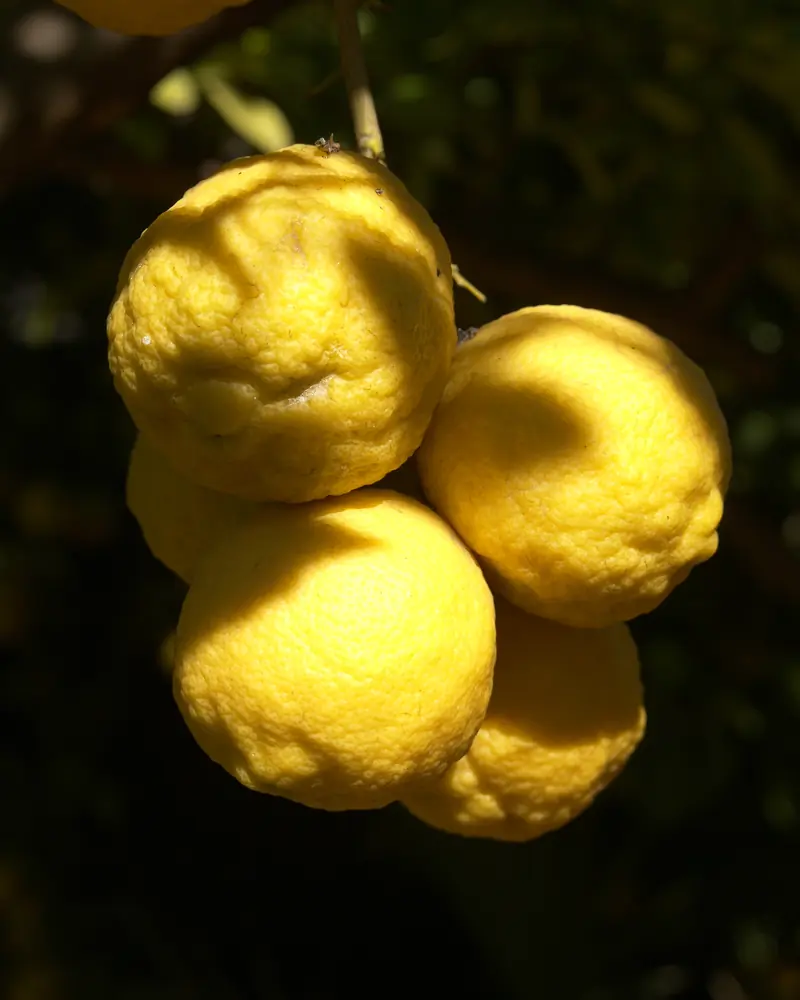
Lemon is the fruit of Citrus limon. Its rind has two layers: an outer coloured zest, aromatic with essential oils, and an inner layer of white spongy pith. As Wikipedia's article on the lemon describes, lemon oil is extracted from the oil-containing cells in the skin: a machine breaks up the cells, a water spray flushes out the oil, and the oil and water mixture is filtered and separated by centrifugation. The Sorrento variety from Italy, with a zest high in lemon oils, is the one traditionally used for limoncello.
What does lemon smell like?
Lemon smells sharp, fresh and juicy, like a freshly grated peel. Much of that signature comes from citral, an aldehyde with a strong lemon scent that is used to fortify lemon oil. The entry on citral describes it as sharp, lemon, sweet, fresh, juicy, tart and green, and names its two forms: neral, a less sweet lemon peel note, and geranial. Citronellal also contributes to the lemon note, but citral is preferred.
What does lemon do in a perfume?
Citrus scents are common top notes, the light materials you smell first, as the article on perfume notes explains and as the class on the fragrance pyramid details. Lemon belongs to the citrus family, and the history of eau de Cologne lists it among the citrus oils of a cologne, next to bergamot, neroli and bitter orange, with lavender, rosemary or petitgrain from orange leaves as possible additions.
What should you know about lemon?
Cold-pressed lemon oil is phototoxic, because it contains furocoumarins. The International Fragrance Association (IFRA) Standard for cold-pressed lemon oil limits it to 2.0% of the finished product in most product categories when the furocoumarin level is unknown, and its use counts toward the combined limit for all phototoxic citrus oils in a formula. Citral is also a known allergen: under EU Regulation 2023/1545, both citral and lemon peel oil must be named on a cosmetic's ingredient list above 0.001% in leave-on products and 0.01% in rinse-off products.
Often paired with
Further reading
- Lemon (Wikipedia) en.wikipedia.org
- Citral (Wikipedia) en.wikipedia.org
- Note (perfumery) (Wikipedia) en.wikipedia.org
- Eau de Cologne (Wikipedia) en.wikipedia.org
- IFRA Standard, Lemon oil cold pressed (Amendment 49, 2020) ifrafragrance.org
- Commission Regulation (EU) 2023/1545 of 26 July 2023 (labelling of fragrance allergens in cosmetic products) eur-lex.europa.eu
Lemon in the feed
beatriz.londonin Wearing Fragrance · London ·
TipScenting my hair through the hairbrush
Small tip from my grandmother in Porto: one spray of lemon and lavender on the hairbrush, not on the hair, then brush. The Class on wearing fragrance on skin, clothes and hair says the alcohol can dry your hair if you spray it every day, so the brush is…
joon.yuzuin Wearing Fragrance · Seattle ·
TipDecanting fragrance for a flight: what works
TL;DR: small refillable atomizer, in a zip bag, in the carry-on. Flying to my sister's for the holidays, so the packing list has started early. What I've tested so far: - full bottle in checked luggage: wrapped in a sock, survived, but I worried the whole…
priya.cardamom Moved this over from Learning to Smell, it fits better here. My three rules: 1) decant only what you'll wear 2) don't fill it to the brim 3) keep it…
liam.saltwaterin Citrus & Fresh · Sydney ·
QuestionA citrus that smells like the beach?
Water's warming up in Sydney. Is there anything citrus that smells like the beach, salt and all?
priya.cardamom I've moved this over from Wearing Fragrance, it's really a materials question. We talk notes here rather than bottles, so answers in materials…
joon.yuzuin Citrus & Fresh · Seattle ·
ReadingWhere citrus sits: French families versus the wheel
TL;DR: citrus is a family of its own in the French classification but only a subfamily on the Fragrance Wheel. - the club's Class on the seven fragrance families follows the French perfumers' seven, citrus first - Wikipedia's article on the Fragrance Wheel…
frankie.incense Fun fact: the wheel had ancestors. The same Fragrance Wheel article mentions Jellinek's Odor Effects Diagram, from 1949, among the earlier schemes [I…
harriet.hayin Welcome to the Club · Bristol ·
Tip
Before you buy anything, open the spice cupboard
A tip for everyone who's joined this autumn, because the same question keeps coming up: what should I buy first? Nothing, honestly. Open the spice cupboard and the fruit bowl. Smell cinnamon next to clove, a lemon next to an orange, a vanilla pod if you have…
mags.lavender Lovely tip, Harriet. I did lavender from the garden next to a sprig of rosemary and learned alot in ten minutes.
joon.yuzuin Citrus & Fresh · Seattle ·
Exercise
Four citrus peels, eyes shut, two right
TL;DR: I blind-tested myself on four citrus peels and got two right. Setup, if you want to copy it: - four peels: lemon, grapefruit, mandarin, sweet orange - each one folded over a paper strip, number on the back - my partner shuffled them, I smelled with my…
aoife_mint Did it with my housemates. Three out of four, I mixed up the lemon and a lime someone threw in to be smart.
In the Classes

Class no. 2 · 6 min read
The fragrance pyramid: top, heart and base notes explained
The fragrance pyramid sorts a perfume's materials by how fast they evaporate: top notes go first, heart notes carry the theme, base notes stay longest. You'll learn to read one, test it on a paper strip and spot what it leaves out.

Class no. 5 · 7 min read
How Fragrance Is Extracted: Distillation, Enfleurage and Absolutes
Perfumers draw scent from plants in five main ways (steam distillation, cold pressing, enfleurage in fat, volatile solvents and supercritical CO2), and each one yields a material with its own name. You'll be able to tell an essential oil from a concrete and an absolute, see why jasmine is kept away from steam, and try three of these methods with an orange in your kitchen.
Class no. 8 · 8 min read
Training your nose: learning to smell with your kitchen cupboard
Training your nose means smelling often, in pairs, and putting a word to each smell: research shows that recognising odours is a skill that improves with practice. By the end of this class you will know how to use a blotter, run a blind test with your spice rack and look after your nose when it gets tired.