Training your nose: learning to smell with your kitchen cupboard
Training your nose means smelling often, in pairs, and putting a word to each smell: research shows that recognising odours is a skill that improves with practice. By the end of this class you will know how to use a blotter, run a blind test with your spice rack and look after your nose when it gets tired.
By the club team ·
You train a nose the way you train an ear: by smelling often, by putting two smells side by side and by hunting for the right word for each. Nobody is born with a vocabulary for odours. It is built, and research on olfactory learning is clear on one point: in people with no training at all, recognising smells gets better with practice.
Everything you need is in your kitchen: spices, herbs, a lemon, a vanilla pod and a few strips of paper. This class gives you the method, a blind test and what research says about a tired nose.
Can you actually train your nose?
Yes. Recognising and naming smells is a skill, and a review of olfactory expertise by Jean-Pierre Royet and colleagues at the Lyon Neuroscience Research Center puts it plainly:
all investigations in naïve subjects have consistently shown that identification performance improves with practice
The same review describes a 1988 experiment in which beginners trained to label specific odours told them apart better the next day. It also reports that student and professional perfumers have more grey matter than untrained people in an orbitofrontal area next to the olfactory sulcus, and that among professionals the volume goes hand in hand with experience. That is an observation about people who smell for a living, not a promise for a Sunday afternoon.
The best-known training routine comes from medicine. In 2009, the Smell and Taste Clinic at the University of Dresden Medical School published a study of olfactory training in patients who had lost part of their sense of smell: twice a day for twelve weeks, they sniffed four intense odours (rose, eucalyptus, lemon, clove). Their smell-test scores improved, while an untrained group stayed the same. It is research on patients and promises nothing to a healthy nose; if your sense of smell fades, that is one for your GP.
How do you smell a blotter properly?
A blotter, or smelling strip, is the basic tool. Wikipedia's article on perfume notes that perfumers commonly use paper blotters, mouillettes in French, to sample and smell perfumes and odorants. A strip keeps your skin out of the equation: you judge the material on its own.
Write a name on the end of the strip before you dip or spray it, give the alcohol a moment to evaporate, then hold it near your nose without touching and breathe normally. One natural sniff is enough: in a 1983 study published in the journal Perception, Laing found that a single natural sniff told people as much about whether an odour was there, and how strong it was, as seven sniffs or more. Extra sniffs mostly confirm, except when you are picking apart a mixture.
Then keep the strip nearby. Smelled after ten minutes, an hour and the next day, it tells the story of evaporation: top notes are small, light molecules that leave first, and the heaviest materials stay to the end. That is the fragrance pyramid, from top notes to base notes, made visible on paper.
Why smell two things side by side instead of one?
Comparison is the fastest teacher, because a smell on its own does not tell you what sets it apart. Cinnamon straight after vanilla can seem sharp; straight after cloves, softer. Royet's review notes that, among the wine tasters studied, experts described smells in analytical terms where novices stayed with an overall impression: comparing is how you learn to take a smell apart. Three formats are enough:
- The named pair: two smells you know, and you look for what separates them.
- The blind pair: someone hands you two unlabelled jars and you say which is which.
- The odd one out: three jars, two of them identical, and you find the intruder. It trains pure discrimination, no vocabulary required.
How do you name a smell when words fail you?
Naming smells is hard for most English speakers, and the nose is not to blame. Radboud University's summary of the study, published on ScienceDaily, describes how psychologist Asifa Majid and linguist Niclas Burenhult compared speakers of Jahai, a hunter-gatherer language of the Malay Peninsula, with English speakers. Jahai speakers named odours as easily as colours, using around a dozen abstract smell words. English speakers fell back on sources (like a banana) or judgements: faced with cinnamon, they came up with spicy, sweet, candy, smoky, wine and potpourri, among others. The summary concludes that being unable to name smells is a matter of culture rather than biology. Good news for you: vocabulary can be learned.
Work in three steps: the source (what does it remind you of?), the family (citrus, spice, herb, wood, flower, resin), then three precise words, the way the International Fragrance Association (IFRA) does it in its Fragrance Ingredient Glossary, which gives each material one primary descriptor and two others. The trade terms, from accord to facet, are covered in the club's guide to fragrance vocabulary.
Which kitchen smells double as a perfumery lesson?
Several everyday spices and herbs carry a molecule that perfumers know well, so smelling them is a way to meet a perfume ingredient in its simplest form. The table lists six, with the three descriptors the IFRA glossary gives each molecule.
| In your kitchen | A molecule worth knowing | IFRA's three descriptors | Smell it next to |
|---|---|---|---|
| Fresh spearmint | (R)-carvone | Minty, Green, Fresh | caraway seeds |
| Caraway seeds | (S)-carvone | Herbal, Fresh, Spicy | spearmint |
| Cinnamon stick | cinnamaldehyde, which gives cinnamon its smell | Spicy, Cinnamon, Warm | cloves |
| Whole cloves | eugenol, 80 to 90 per cent of clove bud oil | Spicy, Clove, Floral | cinnamon |
| Vanilla pod or pure extract | vanillin, among several hundred compounds | Gourmand, Vanilla, Powdery | artificial vanilla flavouring |
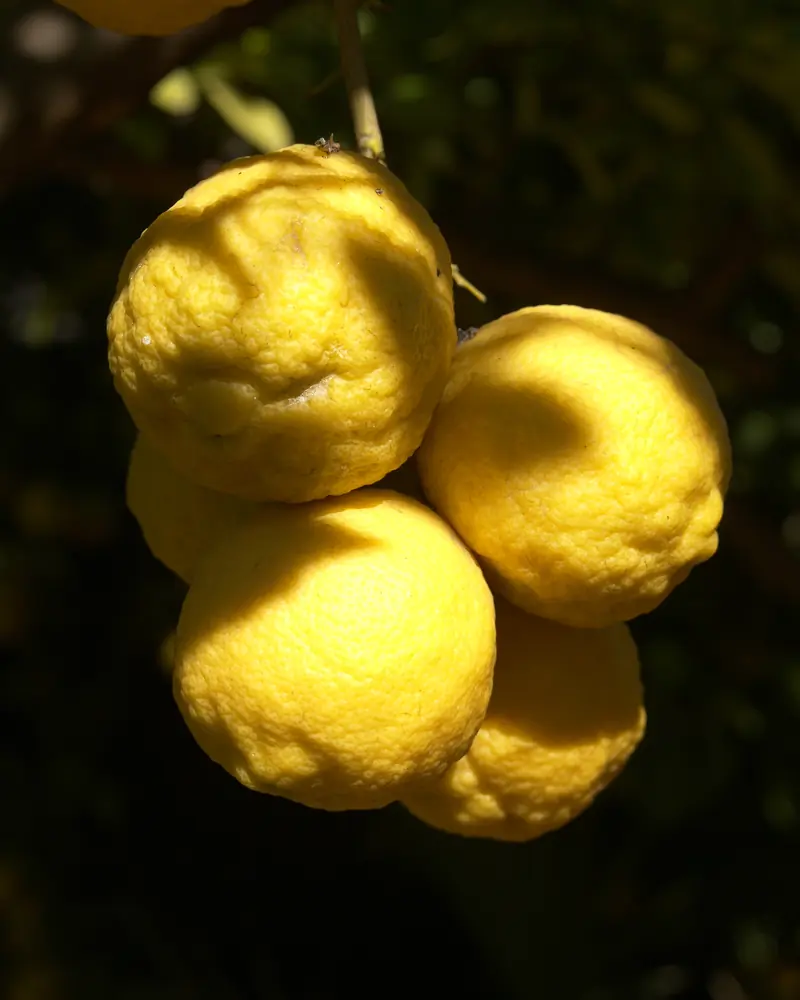
| Lemon zest | citral, also in lemon verbena and lemongrass | Citrus, Lemon, Verbena | bottled lemon juice |
The most surprising pair is the carvones. Spearmint and caraway owe their smell to two forms of one molecule, built from identical atoms but mirror images of each other. Wikipedia's article on carvone points out that the fact they smell different is evidence that our smell receptors respond more strongly to one form than to the other. Cinnamon and cloves have something in common too: eugenol, the main molecule in clove oil, is also extracted from cinnamon, which may be why the two are easy to mix up blindfolded.
Each material has its own page in the club: the lemon note, the cinnamon note, the mint note and the vanilla note.
Exercise: four cupboard pairs, smelled blind
You need a partner and whatever is in your kitchen. Nothing goes on your skin and nothing gets tasted: everything is smelled from a few centimetres away, jar by jar.
- Set out eight identical opaque containers (ramekins or rinsed yoghurt pots) and a notebook. You need four pairs: spearmint and caraway seeds; a cinnamon stick and a few cloves; a split vanilla pod and a blotter dipped in artificial vanilla flavouring; lemon zest and a splash of bottled lemon juice.
- Your partner fills the containers out of sight, covers each with paper pierced with a few holes, and writes what is inside on the bottom.
- Pair by pair, smell the first container with one natural sniff and write three words. Take three breaths through your mouth, smell the second and write three more.
- Say which is which, then turn the containers over. Compare your words with the table: a word that keeps coming back from one session to the next is a word you own.
- Stop after four pairs and get some fresh air. Repeat another day in a different order, and move on to the odd one out once you stop making mistakes.
The vanilla pair sets a natural material against its star molecule: according to Wikipedia's article on vanillin, artificial vanilla flavouring is often a solution of pure vanillin, usually synthetic, while natural extract holds several hundred other compounds.
Why does your nose get tired, and do coffee beans help?
Olfactory fatigue, also called noseblindness, is the drop in sensitivity to a smell you have been breathing for a while, and it targets that smell specifically. In a 1996 study from the Monell Chemical Senses Center in Philadelphia, Dalton and Wysocki exposed volunteers at home, continuously for two weeks, to one of two odours: their sensitivity to that odour dropped, and for most of them the drop could still be measured up to two weeks after the last exposure. It is probably part of the reason your own perfume seems to vanish, the subject of the class on why you stop smelling your own perfume, and how to wear fragrance.
During a session, when the third blotter of the same perfume seems fainter than the first, take a break, get some air and move on to a different material: your nose still works for everything else.
Which brings us to the jar of coffee beans on so many perfume counters, supposed to reset your nose between fragrances. A small exploratory study at Beloit College in Wisconsin tested it in 2011: students smelled three fragrances several times, then sniffed coffee beans, lemon slices or plain air, before picking out which of four fragrances they had not smelled yet. Coffee beans did no better than lemon, or than air. That does not show coffee does harm, only that it has no special power; the study was a modest one, and an open window costs nothing.
How do you keep improving week after week?
The club suggests regular practice over marathon sessions: one short session a week, with a notebook for the material, your three words and anything that surprised you. Change one pair at a time, and share your pairs in the Learning to Smell circle, where members practise together: other people's words are often the ones you were missing.
Lemon Cinnamon Mint Vanilla Clove Vanillin
Further reading
- The impact of expertise in olfaction, Royet, Plailly, Saive, Veyrac and Delon-Martin, Frontiers in Psychology (2013), PMC pmc.ncbi.nlm.nih.gov
- Effects of olfactory training in patients with olfactory loss, Hummel et al., Laryngoscope (2009), PubMed pubmed.ncbi.nlm.nih.gov
- Perfume, Wikipedia en.wikipedia.org
- Natural sniffing gives optimum odour perception for humans, Laing, Perception (1983), PubMed pubmed.ncbi.nlm.nih.gov
- Odors expressible in language, as long as you speak right language, ScienceDaily (2014), from Radboud University Nijmegen sciencedaily.com
- IFRA Fragrance Ingredient Glossary, April 2020 edition, International Fragrance Association ifrafragrance.org
- The nature and duration of adaptation following long-term odor exposure, Dalton and Wysocki, Perception & Psychophysics (1996), PubMed pubmed.ncbi.nlm.nih.gov
- An exploratory investigation of coffee and lemon scents and odor identification, Grosofsky, Haupert and Versteeg, Perceptual and Motor Skills (2011), PubMed pubmed.ncbi.nlm.nih.gov
- Carvone, Wikipedia en.wikipedia.org
- Cinnamaldehyde, Wikipedia en.wikipedia.org
- Eugenol, Wikipedia en.wikipedia.org
- Vanillin, Wikipedia en.wikipedia.org
- Citral, Wikipedia en.wikipedia.org
- Olfactory fatigue, Wikipedia en.wikipedia.org
What members say
Four pairs blind, carvones right every time, cinnamon and clove wrong twice. I logged three words per jar in my spreadsheet and basically half of mine match the IFRA words in the table.
Does peppermint work for the first pair, or does it have to be spearmint? I only have peppermint tea in the flat.
Spearmint is the one, Aoife: the pair works because spearmint and caraway carry the two mirror forms of carvone. Peppermint is a lovely smell to put words to, so keep it for another round.
cinnamon and clove share eugenol?? explains every time i grab the wrong jar on the line. your welcome to laugh
The Jahai have smell words the way we have blue and green, and it puts me in mind of my students who can't hear an interval until someone names it and then they hear it everywhere, so it is.
The coffee jar was always too much bass for me. Plain air between blotters and I hear the treble again.
More Classes

Class no. 9 · 7 min read
Fragrance vocabulary: ten perfume words explained simply
Fragrance vocabulary comes down to ten words you will meet everywhere: note, accord, facet, family, sillage, longevity, concentrate, jus, blotter and flanker. This class defines each one from the French Society of Perfumers' glossary and other reference sources, and shows you how to use them to describe what you smell.
Class no. 10 · 7 min read
How to wear fragrance: where, how much, and why you stop smelling it
To wear fragrance well, spray it from a short distance onto clean skin or a fabric that won't mark, don't rub it in, and stop before your own nose asks for more. You'll learn where to put it, how much to use and why you stop noticing your own scent while everyone around you still can.
Class no. 11 · 7 min read
How to store fragrance: what spoils perfume and where to keep it
Fragrance keeps best in the dark, somewhere cool, at a steady temperature and with as little air as possible, because light, heat and oxygen change it. You will know where to keep your bottles, how to spot one that has turned, and what the open jar symbol on some boxes means.