Precious woods: where sandalwood, oud and cedarwood really come from
Sandalwood, oud and cedarwood come from very different trees, and several are under pressure: Indian sandalwood is listed as vulnerable by the IUCN, every agarwood-producing species is covered by CITES, and Atlas cedar is endangered. You will learn where each wood comes from, what scarcity changes in a perfume, and what the words sandalwood, oud and cedar on a label can and cannot tell you.
By the club team ·
The precious woods of perfumery come from trees that are slow to give up their scent. Indian sandalwood is distilled from the heartwood and roots of a tree that lives partly off other plants' roots; oud comes from a resin that some Asian trees only make after being wounded and infected; and most of the "cedar" in perfume is actually juniper or cypress. Each has its own page in the club: the sandalwood note, the oud note and the cedarwood note.
Two of these materials now sit under international rules. Every agarwood-producing species in the genera Aquilaria and Gyrinops has been listed in Appendix II of CITES since 2004, and Indian sandalwood is classed as vulnerable by the International Union for Conservation of Nature (IUCN). For the perfume on your shelf, that means plantations, substitutes and label words worth reading carefully.
Where does Indian sandalwood come from, and why is it scarce?
Indian sandalwood (Santalum album), also called East Indian sandalwood, grows naturally in India, Sri Lanka and Indonesia. In its 1995 book on flavours and fragrances of plant origin, the FAO describes an oil distilled from the heartwood and roots with a characteristic sweet, woody odour, prized as a fixative because about 90 percent of it is santalols, compounds that evaporate slowly. In India it is the base of traditional attars, where flowers are distilled straight into sandalwood oil.
Santalum album is a root parasite that needs host plants to grow, which makes it hard to cultivate. The same source notes that trees planted outside their natural range give wood of very variable oil content, sometimes with little or no aroma.
India holds most of the resource. According to the Sandalwood Information System of the Institute of Wood Science and Technology in Bangalore, more than 90 percent of the country's sandalwood grows in Karnataka and Tamil Nadu, and timber exports are banned except for handicraft pieces of up to 50 grams. Two researchers from the same institute note, in a 2024 Indian Forester paper on sandalwood grading, that a drastic fall in the number of large trees in wild populations led the IUCN to categorise the species as vulnerable.
How is Australian sandalwood managed?
Western Australian sandalwood (Santalum spicatum) is a different species: a slow-growing, long-lived small tree that is also hemiparasitic. Western Australia's Forest Products Commission harvests up to 2,500 tonnes of wild sandalwood a year, roughly half from live trees and half from dead wood.
Natural regeneration has been poor for more than 50 years, partly because small marsupials such as the woylie, which used to bury the seeds, have largely disappeared. The commission now plants more than five million seeds a year along mechanical rip-lines designed to mimic the woylie, and manages about 6,000 hectares of plantations that will grow until at least age 25 so that oil can develop in the heartwood.
How does a wounded tree make oud?
Oud, or agarwood, is resin-soaked wood produced mainly by trees of the genera Aquilaria and Gyrinops in several Asian countries. The report of the 2022 validation workshop on agarwood held under the CITES Tree Species Programme, published by the International Tropical Timber Organization (ITTO), puts it in one line:
It is formed in the heartwood of (mainly) Aquilaria and Gyrinops trees when they become infected with a type of mould.
The resin is a defence. A 2022 review of agarwood's fragrant molecules in the journal Molecules explains that it helps the tree hold back the microbes invading it, and estimates that only 10 percent of wild Aquilaria trees are infected and produce resin; natural agarwood takes twenty years or more to form. Its scent comes mainly from sesquiterpenes and from rarer molecules, 2-(2-phenylethyl)chromones, linked to the warm, balsamic, lingering sweetness of burning agarwood.
Oud oil is made by steam distillation, mostly from lower-grade chips and powder, according to the 2022 report; the class on how fragrance materials are extracted covers the method. The same report records prices of up to 100,000 US dollars per kilo for top-quality agarwood, and links them to unsustainable levels of extraction.
What does CITES actually control for agarwood?
CITES, the Convention on International Trade in Endangered Species of Wild Fauna and Flora, listed Aquilaria malaccensis in Appendix II in the mid-1990s and added every other agarwood-producing species of Aquilaria and Gyrinops at its 2004 conference, according to a TRAFFIC article on CITES and sustainable forest management, published by the FAO.
Appendix II is not a ban. The TRAFFIC article explains that it covers species not considered as threatened as those in Appendix I but which may become so if trade is not regulated. Trade is allowed under permit, and each export requires the exporting country's scientific authority to find that it will not harm the species' survival.
The listing reaches well beyond raw logs. As presented by the CITES Secretariat in the 2022 report, it covers all parts and derivatives except seeds and pollen, seedlings grown in vitro, fruits, leaves, exhausted agarwood powder, and finished products packaged and ready for retail trade, an exemption that does not apply to wood chips, beads, prayer beads and carvings. In practice, agarwood chips or prayer beads brought home from a trip are not in the same position as a boxed bottle; check the exact rules with customs, as they may have changed since 2022.
Does the "cedar" in a perfume come from a cedar tree?
Usually not. The FAO's 1995 book explains that the most important cedarwood oils are distilled from junipers and cypresses (Juniperus and Cupressus) rather than true cedars (Cedrus). Virginia cedarwood comes from Juniperus virginiana, the eastern red cedar; Texas cedarwood from another juniper; Chinese cedarwood from a cypress, Cupressus funebris. China and the United States were then the main producers.
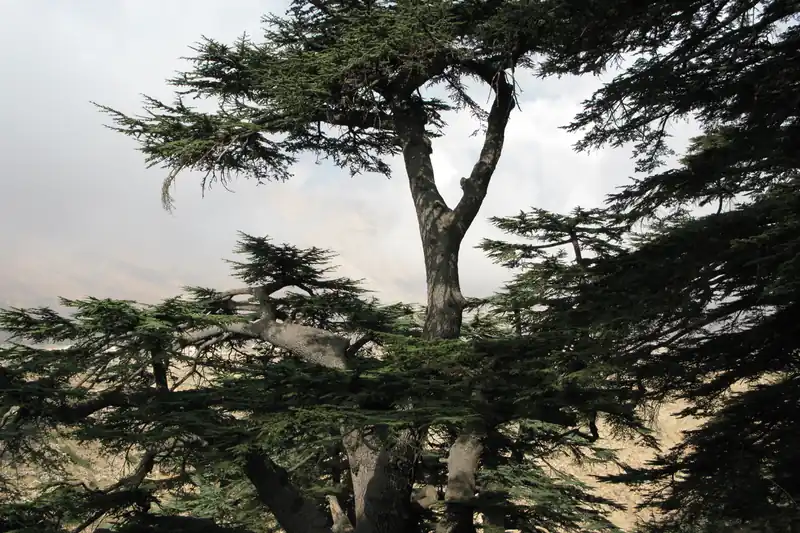
True cedars are used too: Himalayan cedar (Cedrus deodara), distilled in India since the late 1950s, and Atlas cedar (Cedrus atlantica), whose oil Morocco produces in small volumes. The Royal Botanic Garden Edinburgh's page on Atlas cedar among the world's threatened conifers lists it as Endangered on the IUCN Red List. Logging, fire and heavy grazing by goats are the main threats, its area of occupancy is estimated to have shrunk by up to 75 percent between 1940 and 1982, and droughts since the 1980s have added to the decline. Both its timber and its foliage are distilled.
Sandalwood, oud and cedar compared
The woody family, as Mademoiselle Bulle describes it for readers choosing a scent, brings cedar, sandalwood and oud together with vetiver and patchouli, and the club files them in the woody fragrance family too. Behind that shared word, the trees, materials and rules differ a great deal.
| Name in perfumery | Tree and origin | What is used | Status or rules |
|---|---|---|---|
| Indian sandalwood | Santalum album; India, Sri Lanka, Indonesia | Oil distilled from heartwood and roots | Vulnerable (IUCN); timber exports banned in India except handicrafts up to 50 g |
| Australian sandalwood | Santalum spicatum; Western Australia | Wood, oil, incense powder | Wild harvest capped at 2,500 tonnes a year |
| Oud (agarwood) | Aquilaria and Gyrinops; several Asian countries | Resinous wood, chips, distilled oil | CITES Appendix II for all species since 2004 |
| Atlas cedar | Cedrus atlantica; Morocco, Algeria | Oil distilled from timber and foliage | Endangered (IUCN) |
| Virginia, Texas and Chinese "cedar" | Junipers (Juniperus) and cypress (Cupressus); United States, China | Oil distilled from the wood, a source of cedrol and cedrene | The main cedarwood oils in trade, according to the FAO (1995) |
What replaces rare woods in a perfume?
Sandalwood was replaced early. The FAO reported in 1995 that demand for sandalwood oil fell sharply in the 1970s because of very high prices and synthetic substitutes, while the natural oil kept its place in top-grade products. The class on natural versus synthetic ingredients tells the wider story of how chemistry expanded the perfumer's palette.
Cedarwood plays a double role. Its oils scent soaps, household sprays and floor polishes, and their main compounds, such as cedrol and cedrene, are a raw material for the chemical industry, which turns them into new fragrance ingredients, again according to the FAO.
For oud, the answer starts with cultivation. The 2022 report describes plantations where most producing countries now drill the trees and apply a fungal inoculant, and the Molecules review cites trials in which this artificial induction produced agarwood ten times faster than natural formation. In the same report, ITTO's executive director stressed that it is extremely difficult to reproduce the quality of naturally formed material in plantations.
So a perfume labelled oud or sandalwood may contain natural wood, plantation wood, synthetic molecules that suggest it, or a mix: a note name describes a smell, not a guaranteed material. Only the house that made the perfume can say what is inside, and the class on allergens and IFRA standards explains what the single word "parfum" covers in an ingredient list.
Exercise: three woods, no bottle
This takes about fifteen minutes, uses what you have at home, and involves nothing on your skin.
- Gather three dry, untreated woods: a pencil you can sharpen, a wooden spoon or spatula, and a wooden skewer or a slat from a fruit crate. If you have a sandalwood or oud incense stick, add it, unlit.
- Smell each wood as it is, a few centimetres from your nose. Then scratch it with a fingernail or a small file, smell again and note what changes: strength, dryness, a sweet, dusty or resinous edge.
- Dampen one corner of each piece with a drop of water, wait a minute and smell a third time.
- For the unlit incense stick, compare it with your memory of the smoke, and note whether the two tell the same story.
- Share your notes in the Woods, Mosses & Roots circle, where members compare the woods in their everyday lives.
A wood's scent sits inside the material and comes out when you open it up: distilling sandalwood or cedar goes after the same thing, on a very different scale.
Further reading
- Flavours and fragrances of plant origin (J.J.W. Coppen, FAO, 1995), chapters on sandalwood oil and cedarwood oils fao.org
- Sandalwood Information System, Introduction (Institute of Wood Science and Technology, Bangalore) iwst.icfre.gov.in
- Reassessing Indian Sandalwood Grading: Towards a Comprehensive Market Friendly System (Indian Forester, vol. 150, no. 3, March 2024) indianforester.co.in
- Sandalwood (Forest Products Commission, Government of Western Australia) wa.gov.au
- Report of the CITES Tree Species Programme Validation Workshop on Agarwood Report (Kuala Lumpur, 20-22 June 2022, ITTO and CITES) itto.int
- Agarwood: The Fragrant Molecules of a Wounded Tree (Molecules, 2022, 27(11):3386) pmc.ncbi.nlm.nih.gov
- CITES, trade and sustainable forest management (H.K. Chen and S. Zain, TRAFFIC International, published by the FAO) fao.org
- Cedrus atlantica (Threatened Conifers of the World, Royal Botanic Garden Edinburgh) threatenedconifers.rbge.org.uk
What members say
Nice to see WA sandalwood in here. I grew up around it and never knew it was hemiparasitic, it just looked like a scrubby little tree to me.
Did the exercise with cedar shavings from the studio floor and a pencil. Once scratched, the pencil came out sweeter then the shavings, which I didn't expect.
The incense we burn at Eid says oud on the box. Is there any way to know if it's actual agarwood?
Amara, the box alone can't tell you: the word describes a smell, and only the maker's declared composition can say what's in it. Try smelling a stick unlit, like step 4 of the exercise, and tell us how it compares with the smoke. Over to you.
So a cedar note can come from a juniper. Wee revelation for a dreich afternoon.
I tried the drop of water on an old blackthorn stick that lives by the door and the smell came up slow and dark and I'd never have guessed it was in there at all.
More Classes
Class no. 18 · 6 min read
Scenting your home: what candles, incense and diffusers do to the air
Scenting your home without degrading the air comes down to two habits that UK and US health guidance share: cut back on the source, and ventilate while and after you use it. You will learn what a candle, an incense stick, a spray or a diffuser releases, and how to enjoy a scent at home without burning anything.

Class no. 19 · 8 min read
Smell and memory: why a scent brings a memory flooding back
According to research, a smell brings back a memory because the olfactory bulb connects directly to the brain areas that handle emotion and memory, and because childhood smells are laid down through happy moments repeated many times. By the end you'll be able to tell the solid findings from the folklore, and to test the effect on yourself with things from your kitchen.

Class no. 20 · 7 min read
Becoming a perfumer: training, related jobs and what 'nose' means
You become a perfumer through specialist training, at ISIPCA in Versailles, the Grasse Institute of Perfumery or after a science degree, then years of smelling raw materials every day. You'll come away knowing who does what around a fragrance, what the schools actually test for, and what the word 'nose' really covers.